
UNESCO World Heritage Sites in Bangladesh: A Complete Guide to the Country's Cultural and Natural Treasures
Bangladesh may be a relatively small country, but its cultural and natural heritage is truly remarkable. From centuries-old mosques and one of the world's largest Buddhist monasteries to the largest mangrove forest on Earth, Bangladesh is home to places and traditions that have earned global recognition from UNESCO.
Many visitors know Bangladesh for its warm hospitality, rivers, tea gardens, and the Royal Bengal Tiger. However, few realize that the country also preserves some of South Asia's most significant historical monuments and living traditions. These places and cultural practices tell the story of Bengal's rich history, diverse communities, artistic achievements, and deep connection with nature.
Today, Bangladesh has three UNESCO World Heritage Sites and six UNESCO Intangible Cultural Heritage elements, each representing a unique part of the nation's identity.
Whether you are interested in history, architecture, archaeology, wildlife, or traditional culture, Bangladesh offers experiences that are both authentic and rewarding.
In this guide, we'll explore every UNESCO-recognized heritage of Bangladesh, why it matters, and why these places deserve a place on every traveler's itinerary.
________________________________________
What is UNESCO?
UNESCO stands for the United Nations Educational, Scientific and Cultural Organization. Established in 1945, UNESCO works to protect the world's most valuable cultural and natural heritage while encouraging international cooperation in education, science, and culture.
UNESCO recognizes heritage in two main categories:
UNESCO World Heritage Sites
These are places considered to have Outstanding Universal Value. They may include historic cities, archaeological sites, monuments, forests, mountains, or other natural landscapes that are important not only to one country but to all of humanity.
UNESCO Intangible Cultural Heritage
Unlike World Heritage Sites, this category protects living traditions rather than physical places. These include music, festivals, craftsmanship, performing arts, and cultural practices that communities continue to preserve and pass from one generation to another.
Both categories play an important role in protecting Bangladesh's rich heritage for future generations.
________________________________________
UNESCO World Heritage Sites in Bangladesh
Bangladesh currently has three UNESCO World Heritage Sites. Two are recognized for their cultural importance, while one is celebrated for its outstanding natural value.
________________________________________
1. Historic Mosque City of Bagerhat
UNESCO Inscription: 1985
Location: Bagerhat District, Khulna Division
A Medieval City Built Around Faith and Planning
The Historic Mosque City of Bagerhat is one of the finest surviving examples of medieval Islamic architecture in the Bengal region. It was established during the 15th century by the Turkish general, administrator, and saint Khan Jahan Ali, who transformed a once forested area into a thriving settlement.
Unlike many historic cities that developed gradually over time, Bagerhat was carefully planned. Roads, reservoirs, bridges, mosques, and public buildings were constructed in a well-organized layout, demonstrating remarkable urban planning for its time.
Today, visitors can still see dozens of monuments that reflect the city's architectural and historical importance.
The Famous Sixty Dome Mosque
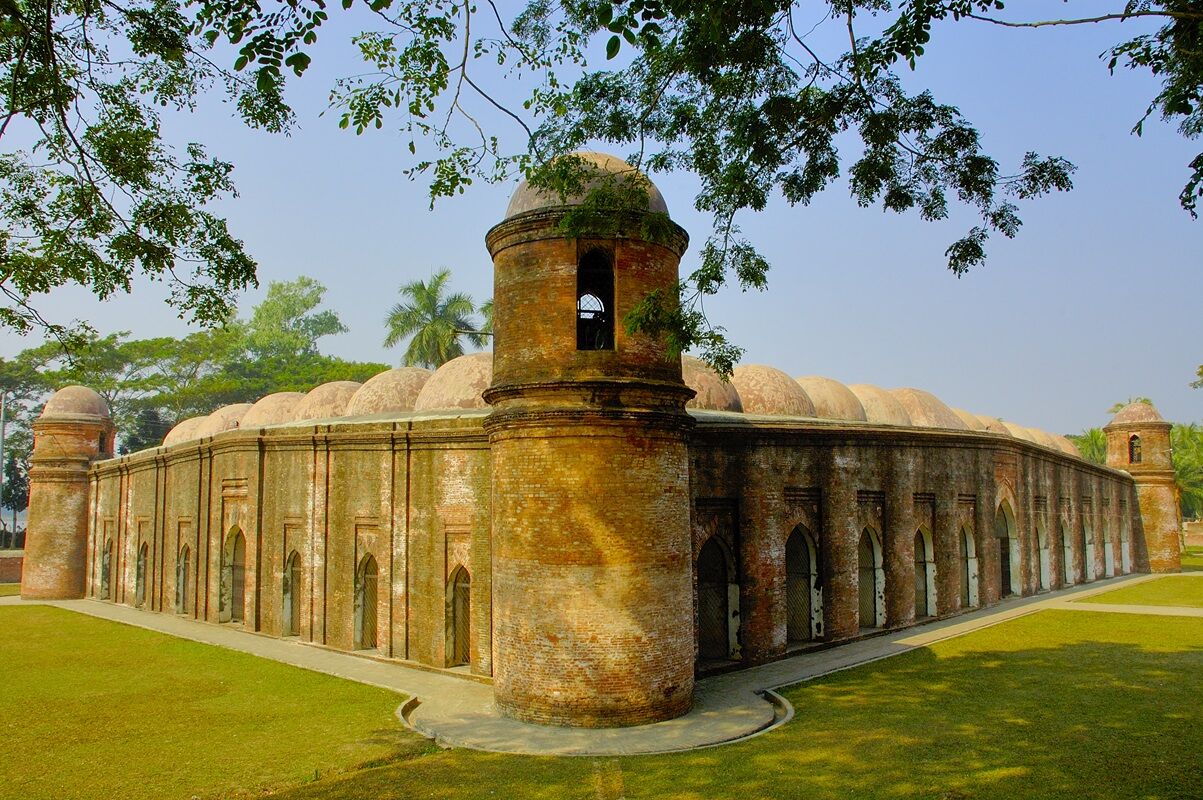
The best-known monument in Bagerhat is the Sixty Dome Mosque, locally known as Shat Gombuj Mosque.
Interestingly, the mosque does not have sixty domes. Instead, it features 77 low domes supported by rows of stone columns, along with four corner towers. Historians believe that the name "Shat Gombuj" originally referred to "many domes" rather than the number sixty.
Built entirely of brick with thick walls and graceful arches, the mosque remains one of the largest surviving mosques from the Bengal Sultanate.
Other Important Monuments
Beyond the Sixty Dome Mosque, the heritage city includes many other remarkable structures, including:
• Khan Jahan Ali's Mausoleum
• Nine Dome Mosque
• Singair Mosque
• Bibi Begni Mosque
• Ghora Dighi, one of the area's largest historic reservoirs
Each monument reflects the distinctive style of Bengal Sultanate architecture, which adapted Islamic design to local materials and climatic conditions.
Why UNESCO Recognized Bagerhat
UNESCO recognizes Bagerhat as an outstanding example of a medieval Islamic city that successfully combined religious architecture, urban planning, and environmental adaptation.
The city also demonstrates how Islamic civilization flourished in the Bengal Delta while developing a unique regional architectural identity.
Visiting Bagerhat
Most travelers visit Bagerhat as a day trip from Khulna, although staying overnight allows more time to explore the area's historic monuments and nearby attractions.
Best Time to Visit: November to February
________________________________________
2. Ruins of the Buddhist Vihara at Paharpur (Somapura Mahavihara)
UNESCO Inscription: 1985
Location: Naogaon District, Rajshahi Division
One of South Asia's Greatest Buddhist Monasteries
Located in northwestern Bangladesh, Somapura Mahavihara is one of the largest and most important Buddhist monasteries ever built in South Asia.
Construction began during the late 8th century under the rule of the Pala Dynasty, one of the greatest Buddhist empires of the region.
For several centuries, monks and scholars from across Asia traveled here to study Buddhism, philosophy, science, literature, and art. At its peak, the monastery served as an international center of learning comparable to Nalanda in present-day India.
Remarkable Architecture
The monastery occupies nearly 11 hectares (27 acres) and follows a carefully planned rectangular layout.
At its center stands a massive cruciform temple surrounded by 177 monks' cells, arranged around a spacious courtyard.
Archaeological excavations have uncovered thousands of remarkable artifacts, including:
• Terracotta plaques
• Stone sculptures
• Bronze statues
• Pottery
• Coins
• Inscriptions
• Decorative carvings
These discoveries provide valuable insight into religious life and artistic excellence during the Pala period.
Influence Beyond Bangladesh
One of the reasons UNESCO recognizes Somapura Mahavihara is its influence on Buddhist architecture across Asia.
Its design inspired later monasteries and temples in Nepal, Myanmar, Indonesia, and other parts of Southeast Asia, making it one of the most influential religious monuments of its time.
Paharpur Museum
A visit to the site is best complemented by the nearby museum, which houses many original artifacts recovered during archaeological excavations.
Together, the ruins and museum offer visitors a deeper understanding of one of the most significant archaeological discoveries in Bangladesh.
Best Time to Visit: October to March
________________________________________
3. The Sundarbans
UNESCO Inscription: 1997
Location: Khulna Division
The World's Largest Mangrove Forest
The Sundarbans is not only Bangladesh's most famous natural attraction but also the largest mangrove forest on Earth.
Covering approximately 10,000 square kilometres across Bangladesh and India, around 60 percent of the forest lies within Bangladesh.
This vast network of rivers, tidal waterways, mudflats, and mangrove forests forms one of the planet's most productive and biologically diverse ecosystems.
More importantly, the Sundarbans serves as a natural shield that protects Bangladesh's southern coastline from cyclones, tidal surges, and coastal erosion.
Home of the Royal Bengal Tiger
The Sundarbans is internationally known as the home of the Royal Bengal Tiger, one of the world's most iconic wild cats.
However, the forest supports far more than just tigers.
Wildlife found in the Sundarbans includes:
• Estuarine Crocodile
• Spotted Deer
• Fishing Cat
• Smooth-coated Otter
• Water Monitor Lizard
• Irrawaddy Dolphin
• Gangetic Dolphin
• Over 300 species of birds
• Hundreds of species of fish, reptiles, and plants
Its incredible biodiversity makes the Sundarbans one of the world's most important wetland ecosystems.
Life in the Sundarbans
Thousands of people living around the forest depend on its natural resources for their livelihoods.
Fishermen, honey collectors, and crab harvesters have worked in harmony with this unique environment for generations. Their knowledge of tides, wildlife, and seasonal changes forms an important part of the region's cultural heritage.
Exploring the Forest
Unlike a traditional national park, the Sundarbans is best explored by boat.
Most tours depart from Mongla or Khulna and travel through narrow rivers and creeks, offering opportunities to observe wildlife, watch birds, and experience the peaceful beauty of the mangrove forest.
Whether you spend two days or four, visiting the Sundarbans is unlike any other travel experience in Bangladesh.
Best Time to Visit: November to March
UNESCO Intangible Cultural Heritage of Bangladesh
While UNESCO World Heritage Sites protect monuments, archaeological sites, and natural landscapes, the Intangible Cultural Heritage List celebrates living traditions that continue to shape people's lives. These include music, festivals, craftsmanship, performing arts, and traditional knowledge passed down through generations.
As of 2026, Bangladesh has six elements inscribed on UNESCO's Representative List of the Intangible Cultural Heritage of Humanity. Together, they reflect the country's creativity, craftsmanship, and cultural diversity.
________________________________________
1. Baul Songs
UNESCO Inscription: 2008
Among Bangladesh's most treasured cultural traditions are the Baul songs, performed by wandering mystic musicians known as Bauls. More than just entertainers, Bauls are spiritual seekers whose songs express themes of humanity, love, inner peace, and the search for truth beyond religious boundaries.
Their music is simple yet deeply meaningful, often accompanied by traditional instruments such as the ektara, dotara, duggi, and khamak. Rather than following formal religious practices, Baul philosophy emphasizes compassion, tolerance, and the divine presence within every human being.
No discussion of Baul music is complete without mentioning Lalon Shah (Lalon Fakir), the legendary philosopher, poet, and composer whose songs continue to inspire generations of musicians throughout Bangladesh and West Bengal. His shrine at Cheuriya in Kushtia remains an important gathering place for Baul practitioners and visitors interested in Bengali folk culture.
Today, Baul music can still be experienced at traditional festivals, village gatherings, and cultural events across the country.
________________________________________
2. Traditional Art of Jamdani Weaving
UNESCO Inscription: 2013
The Jamdani is one of the finest handwoven textiles in the world and a proud symbol of Bangladesh's textile heritage.
This centuries-old weaving tradition is practiced mainly in Rupganj and surrounding areas near Sonargaon, where skilled artisans create intricate floral and geometric patterns directly into fine cotton fabric using a technique known as the supplementary weft.
Unlike machine-made textiles, every Jamdani saree is woven entirely by hand. Depending on the complexity of the design, completing a single saree may take several weeks or even months.
Jamdani weaving represents not only artistic excellence but also the preservation of traditional knowledge that has been passed from one generation of weavers to the next.
________________________________________
3. Traditional Art of Shital Pati Weaving of Sylhet
UNESCO Inscription: 2017
The Shital Pati is a finely woven cooling mat made from the Murta plant, which grows naturally in the wetlands of northeastern Bangladesh.
For centuries, artisans in the Sylhet region have transformed strips of Murta into beautiful mats known for their smooth texture, durability, and decorative patterns.
Although originally made for everyday household use, Shital Pati has evolved into an important traditional handicraft, with many artisans producing decorative pieces for homes and cultural exhibitions.
The weaving process requires considerable patience and skill, from harvesting and preparing the reeds to creating intricate geometric designs using natural materials.
UNESCO recognized this tradition for preserving an important form of craftsmanship that supports rural communities while promoting sustainable use of natural resources.
________________________________________
4. Mangal Shobhajatra
UNESCO Inscription: 2016
Every year on 14 April, thousands of people gather in Dhaka to celebrate the Bengali New Year with Mangal Shobhajatra, one of the country's most vibrant cultural events.
Organized by the Faculty of Fine Arts at the University of Dhaka, the procession features giant handcrafted masks, colorful sculptures, traditional music, and folk performances.
Each artwork carries symbolic meaning, representing peace, harmony, courage, and hope for the coming year.
Although it began as a local celebration, Mangal Shobhajatra has grown into a national event that reflects Bangladesh's cultural identity and commitment to diversity and social unity.
________________________________________
5. Rickshaws and Rickshaw Painting in Dhaka
UNESCO Inscription: 2023
Few images represent Bangladesh more vividly than the colorful cycle rickshaws of Dhaka.
For decades, local artists have decorated rickshaws with hand-painted scenes inspired by nature, village life, wildlife, cinema, historical figures, and popular culture. Every rickshaw becomes a unique piece of moving art.
UNESCO recognized not only the artistic paintings but also the craftsmanship involved in building and decorating these iconic vehicles.
Today, rickshaw art remains one of Bangladesh's most recognizable forms of urban folk culture and continues to support the livelihoods of skilled painters and craftsmen.
________________________________________
6. Traditional Saree Weaving Art of Tangail
UNESCO Inscription: 2025
The Tangail saree is one of Bangladesh's most admired traditional textiles, known for its lightweight fabric, elegant borders, and finely woven motifs.
The weaving tradition originated in Tangail District, where generations of artisan families have preserved the craft through hands-on learning and community practice.
Using handlooms, weavers produce sarees with intricate floral and geometric patterns, combining artistic creativity with remarkable technical skill. The process involves preparing the yarn, designing the motifs, weaving the fabric, and carefully finishing each saree by hand.
UNESCO recognized the tradition for its cultural importance, its role in preserving traditional craftsmanship, and its contribution to the social and economic life of weaving communities.
________________________________________
Bangladesh's UNESCO Tentative World Heritage Sites
Before a place can become a UNESCO World Heritage Site, it must first be included on the country's Tentative List. These are sites that Bangladesh has identified as having potential Outstanding Universal Value.
Some of the most significant sites currently on Bangladesh's Tentative List include:
Lalbagh Fort, Dhaka
A 17th-century Mughal fort complex featuring a mosque, museum, gardens, and the beautiful Tomb of Pari Bibi. It remains one of Old Dhaka's most visited historical attractions.
Mahasthangarh, Bogura
The oldest known archaeological site in Bangladesh, dating back more than 2,000 years. It was once the ancient city of Pundranagara, an important urban center in early Bengal.
Kantaji Temple, Dinajpur
Built during the 18th century, this magnificent Hindu temple is famous for its elaborate terracotta decorations depicting scenes from the Ramayana, Krishna's life, and everyday village activities.
Lalmai–Mainamati Archaeological Sites, Cumilla
A collection of ancient Buddhist monasteries, temples, and archaeological remains that provide valuable evidence of Buddhist civilization in southeastern Bengal.
Ancient Capital of Sonargaon
Once the historic capital of Bengal, Sonargaon is known for its rich trading history, traditional crafts, historic mosques, and the Folk Art and Craft Museum. It remains one of Bangladesh's most important cultural destinations.
Although these places have not yet received UNESCO World Heritage status, they are among the country's most significant historical landmarks and are well worth visiting.
________________________________________
Tips for Visiting UNESCO Sites in Bangladesh
If you plan to explore Bangladesh's UNESCO heritage, a little preparation can make your journey more enjoyable.
• The best time to visit most heritage sites is between November and March, when the weather is cooler and drier.
• Dress modestly when visiting mosques, temples, monasteries, and other religious sites.
• Hire a knowledgeable local guide to better understand the history and significance of each destination.
• Carry drinking water, sunscreen, and insect repellent, especially for outdoor sites and the Sundarbans.
• Allow enough travel time, as UNESCO sites are spread across different regions of Bangladesh.
________________________________________
Frequently Asked Questions
How many UNESCO World Heritage Sites are there in Bangladesh?
Bangladesh has three UNESCO World Heritage Sites.
How many UNESCO Intangible Cultural Heritage elements does Bangladesh have?
As of 2026, Bangladesh has six UNESCO-recognized Intangible Cultural Heritage elements.
Which is the only natural UNESCO World Heritage Site in Bangladesh?
The Sundarbans is the country's only natural UNESCO World Heritage Site.
What is Bangladesh's oldest UNESCO World Heritage Site?
Both the Historic Mosque City of Bagerhat and the Ruins of the Buddhist Vihara at Paharpur were inscribed in 1985, making them Bangladesh's first UNESCO World Heritage Sites.
Can tourists visit all UNESCO sites in Bangladesh?
Yes. All three UNESCO World Heritage Sites are open to visitors, although some areas within the Sundarbans require permits and must be visited with authorized guides.
Footprint Tours BD
Travel enthusiast at Footprint Tours BD. Passionate about showcasing the beauty and culture of Bangladesh.
View all postsEnjoyed this article?
Get more travel guides delivered to your inbox.